There Was Always More to It Than Being “Bendy”
Looking back at George’s childhood with Ehlers-Danlos syndrome — the appointments, orthotics, specialist equipment and the long road to finally getting a diagnosis.
Looking back at George’s childhood with Ehlers-Danlos syndrome — the appointments, orthotics, specialist equipment and the long road to finally getting a diagnosis.
I recently read a BBC article about hypermobility and hEDS, and it sent me down something of a memory lane.
George is 22 now. When we’re out somewhere, people see a young man who walks independently. They might notice that he walks more slowly, or that we stop and sit down quite regularly, but there is an awful lot they wouldn’t know just by looking at him.
Looking back at photographs of George as a little boy, I realise the same was true then.
He was smiling, playing, going to school, messing about on computers and doing all the ordinary things children do.
Behind those photographs, though, were years of appointments, fittings, specialist equipment and questions about why his body seemed to work rather differently from everybody else’s.
“He’ll grow out of it”
We knew from a very young age that something wasn’t quite right.
George’s orthotist knew him from the age of two. In fact, she later told me that when he was just three years old, she had written in her notes that she suspected Ehlers-Danlos syndrome.
She couldn’t tell me that at the time. She was an orthotist, not a doctor, and diagnosing EDS wasn’t within her remit.
It would be another eight years before somebody finally gave George that diagnosis.
In the meantime, I repeatedly heard that he would “grow out of it”.
His paediatrician frequently described him as “floppy”. We also heard words such as “bendy”, which sound fairly innocuous when you consider everything that can actually come with the condition.
Eventually, after being told yet again that George would grow out of it, I started finding out for myself how I could get George properly assessed.
Finally getting an answer
Our GP referred George to Professor Rodney Grahame, who was one of the leading specialists in hypermobility and Ehlers-Danlos syndrome.
We had to see Professor Grahame privately.
George was 11 by then and he had the day off school. We took the train to Euston, then a cab to the Hospital of St John & St Elizabeth in St John’s Wood, where Professor Grahame headed the Hypermobility Unit.
Professor Grahame examined George thoroughly.
The usual Beighton score for assessing joint hypermobility only looks at a limited number of joints and movements. Professor Grahame found that George was hypermobile throughout his body, including areas the Beighton score doesn't cover.
Even his spine was hypermobile.
George was diagnosed with Ehlers-Danlos syndrome, hypermobility type — what we would now call hypermobile Ehlers-Danlos syndrome, or hEDS.
After all those years of being told George would grow out of it, we finally had an answer.
And when I told his orthotist?
She wasn't surprised.
Piedros, splints, DAFOs and heel cups
Orthotics had already been part of George’s life for years by then.
He started with Piedro boots. These were specialist medical footwear supplied through orthotics and made for him.
When George moved to special school, he had progressed from Piedros to splints. Later came DAFOs (Dynamic Ankle Foot Orthoses).
Having the moulds made was quite a procedure. His orthotist would plaster his legs to make them, but because she'd known him since he was tiny, she would laugh and joke with him while she worked.
Then came the important bit as far as a child was concerned: choosing what his new splints or DAFOs were going to look like.
There were all sorts of colourful designs and patterns available for children.
One of my favourite photographs from this period shows George sitting on the floor at home playing with his wooden railway. He's smiling at the camera, and above his shoes you can see his bright blue splints.
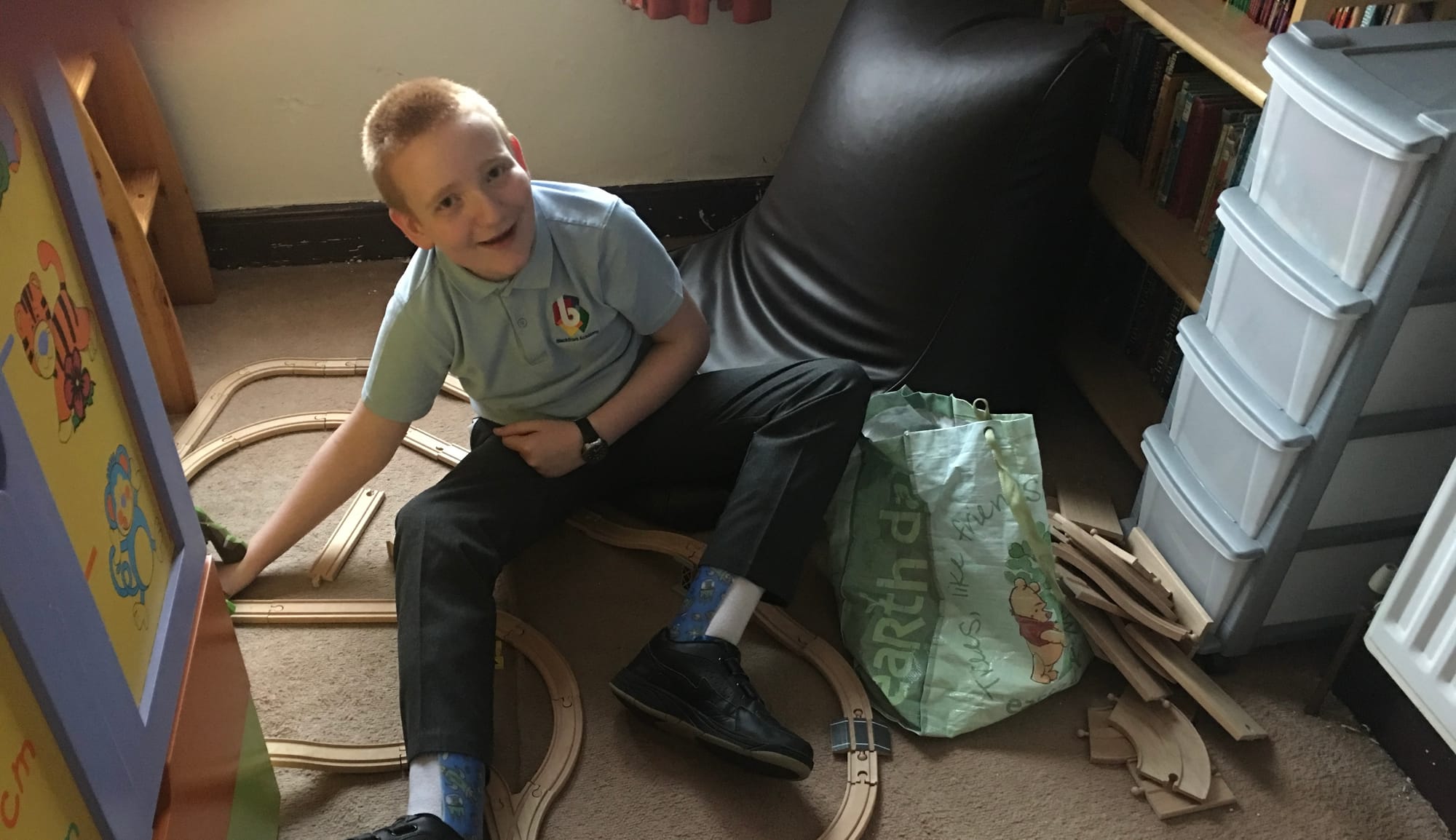
Those splints went over his socks and inside his shoes.
And goodness, did he get through shoes.
Ordinary shoes aren't designed to have rigid orthotics fitted inside them, and they wore out remarkably quickly. It became an expensive part of life with splints and DAFOs, although I suppose the fact that his earlier Piedros had been supplied through orthotics and I hadn't needed to buy shoes then probably evened things out a little.
Today, George only needs heel cups.
When he was fitted for them, the same orthotist who had known him since he was two told me something I've never forgotten.
She said that because I had persevered with all the different things George had needed over the years, that was the reason why they were able to use heel cups now.
All those appointments. All those plaster moulds. All those splints and DAFOs.
They had mattered.
The £2,500 trike
Walking was difficult for George too.
He could walk, but his legs hurt and he tired easily. Longer days sometimes meant using a wheelchair.
Cycling presented another problem.
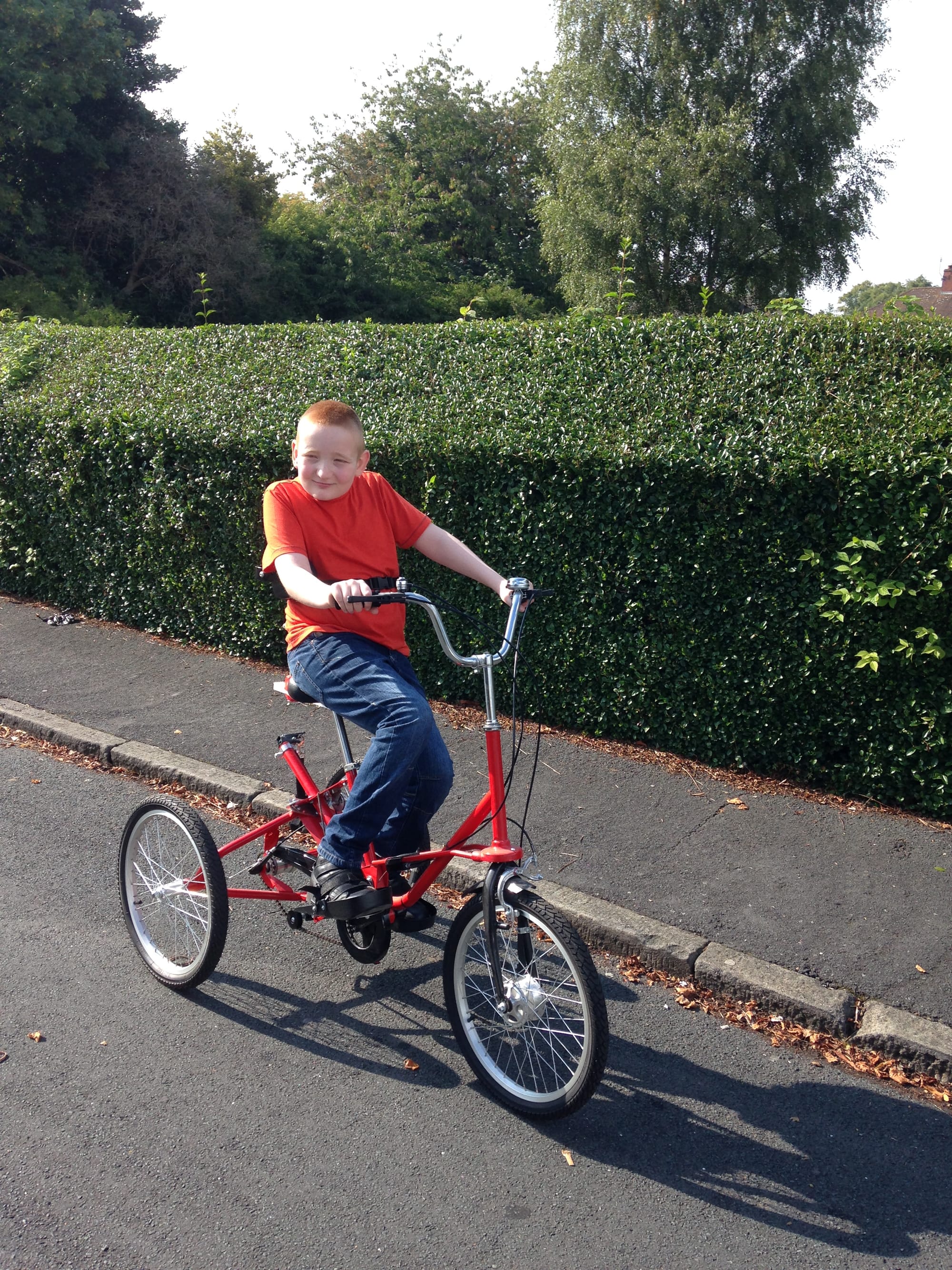
We arranged for a specialist company to assess George at his primary school because there was plenty of room there. They came during lesson time, when the playground was empty, and brought different adapted trikes for him to try.
The reception staff commented on how lovely it was to see him riding around because he looked so happy.
Once they'd worked out what suited him, they measured him and later sent me a quote.
£2,500.
It was a huge amount of money for us, but fortunately a good friend helped us out with some of the cost.
When George’s own trike had been made, he had another day off school and we drove to Gloucester to collect it.
I can still remember that enormous grin as he tried it in the car park.
And that trike did something much more important than simply give him a bicycle.
It meant George was able to take part in Bikeability at primary school alongside his classmates.
There was plenty you couldn't see
EDS wasn't only affecting George’s joints.
His digestive system was, and still is, very definitely affected.
Professor Grahame also thought George was likely to have POTS — Postural Orthostatic Tachycardia Syndrome. POTS affects the autonomic nervous system and can cause an excessive increase in heart rate after becoming upright, with symptoms that can include dizziness, light-headedness, weakness and sometimes fainting.
One particular incident from George’s special school has always stuck in my mind.
His English teacher told me that he'd terrified her one day. At the end of the lesson George stood up from his chair, went white and became extremely wobbly.
She quickly made him sit back down.
It wasn't the only time something like that happened, so Professor Grahame's suspicion of POTS certainly made sense.
He also talked to us about the association being seen between hypermobility and autism. George had already been diagnosed as autistic when he was five, so that was another interesting piece of the jigsaw.
Looking at the little boy now
Writing about this has been surprisingly difficult.
George probably doesn't remember much of the earliest part of it.
It was all he knew.
Going to orthotics, having his legs plastered for moulds, choosing patterns for splints, wearing specialist boots, having appointments and being measured for equipment — that was simply part of being George.
I remember it because I was the one taking him.
And looking back at photographs now can catch me out.
I see little George sitting on the floor playing with his wooden railway and suddenly I'm not just looking at a happy child.
I notice the blue splints.
And I remember everything that went with them.
The appointments. The shoes. The fittings. The pain. The tiredness. The wheelchair. The trike. The questions. The years of being told he'd grow out of it.
But I also see the child himself.
The little boy with the enormous grin on his specially made trike.
The boy who got to join his classmates for Bikeability.
The boy playing with his railway.
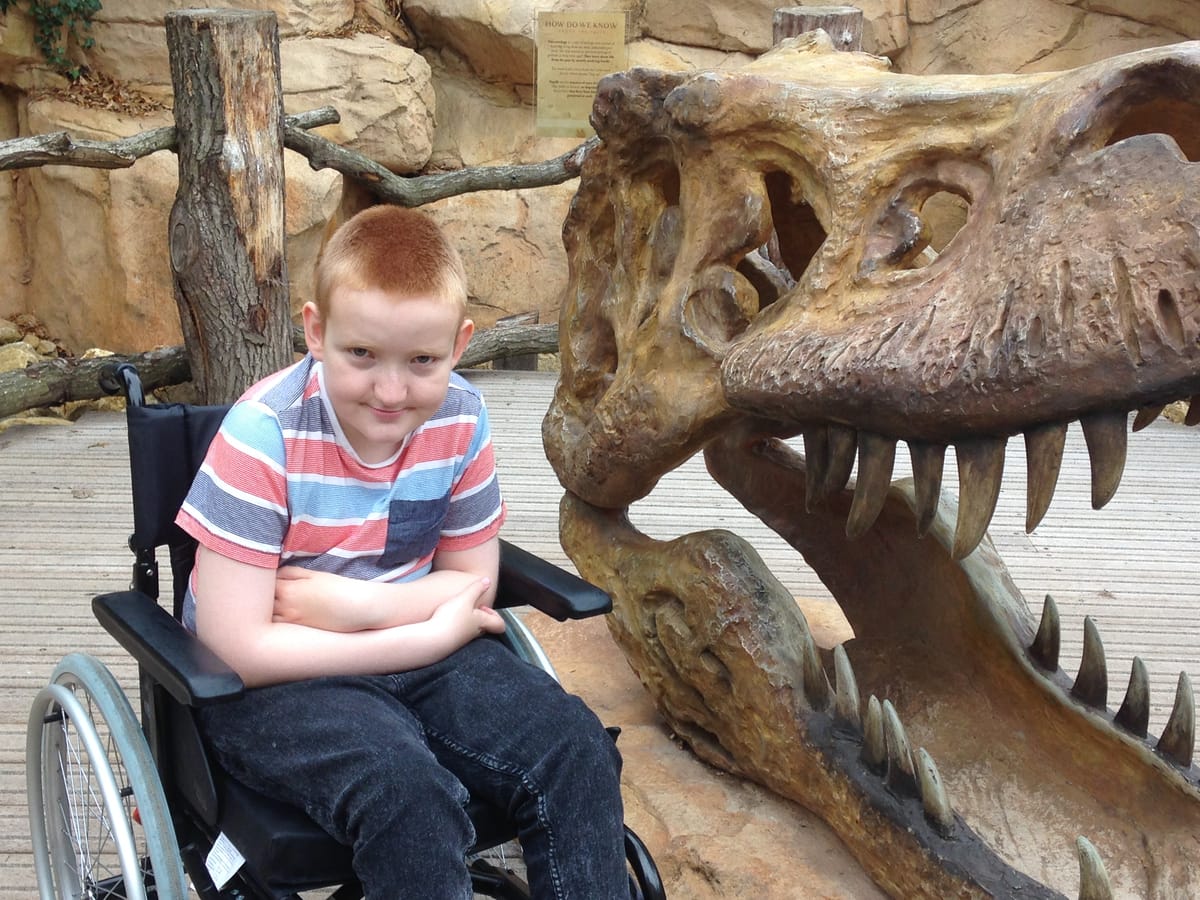
The boy sitting beside a dinosaur skull in his wheelchair on his 11th birthday.
The specialist equipment wasn't his childhood.
It helped him have his childhood.
George today
George is 22 now.
He still has hEDS - there is no cure. He still gets pain in his legs, tires and walks more slowly. When we're out, he needs regular opportunities to stop and rest.
And that's one of the reasons our accessibility reviews look beyond whether somewhere has ramps, lifts and accessible toilets.
How far is it from the disabled parking?
How much walking is involved?
Are there hills?
Are there places to sit along the way?
Will somebody have to stand in a queue for a long time?
Can you stop when you need to?
For somebody like George, those things can make the difference between an enjoyable day out and one that simply asks too much of his body.
The 22-year-old George looks very different from the little boy in these photographs.
The Piedros are gone. So are the splints and DAFOs. We do still have the heel cups, and likely always will. The wheelchair isn't used as frequently. The little red adapted trike belongs to another chapter of his life.
He has grown up.
But the condition he was finally diagnosed with at 11 is still part of his life today.
There was always far more to it than simply being “bendy” or “floppy”.
Planning your own day out? See our full UK carer ticket and disabled admission directory — carer policies, disabled parking and access notes for every place we have reviewed.