Could Glide Change John's Life? Preparing for a New Kind of Independence
Imagine being completely convinced that you're walking in a straight line, only to discover that you've wandered into the road.
Imagine being completely convinced that you're walking in a straight line, only to discover that you've wandered into the road.
For John, who has been totally blind since birth, this is one of the challenges of getting around independently. He doesn't always realise when he's veering off course, and sometimes I have to shout to stop him walking into danger.
We're hoping that a new mobility aid called Glide could eventually make an enormous difference to his independence.
But there's quite a bit of preparation to do first, and we've decided to document the journey.
What is Glide?
Glide is a mobility aid being developed by Glidance to help people with sight loss navigate their surroundings.
I tend to describe it as being a bit like a “robotic guide dog”, although that's my description rather than the manufacturer's!
It's designed to guide the user along a route and help them navigate obstacles. Unlike a traditional guide dog, however, it's a technological device rather than an animal.
You can find out more about the device on the Glidance website.
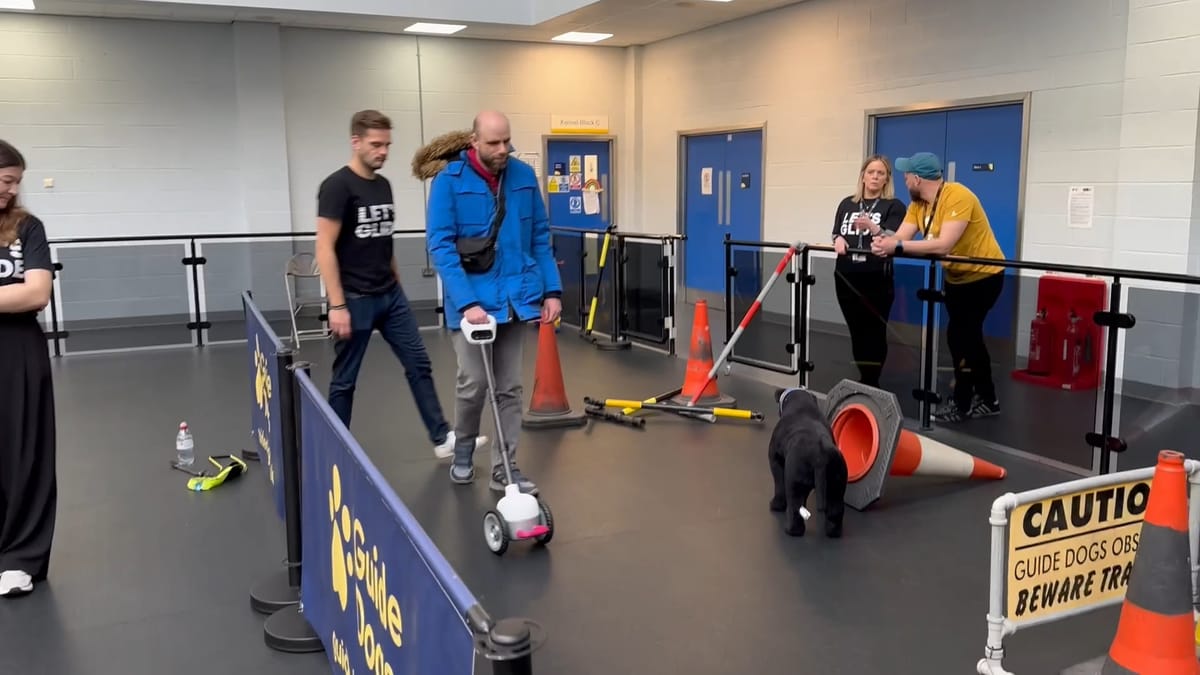
John had an opportunity to try Glide at Northwest Guide Dogs in November 2025, and he was extremely impressed.
In fact, he described the experience as a “total game changer”.
We're hoping he might be able to get his own Glide towards the end of 2027. In the meantime, there's plenty to work on.
Why does John struggle with orientation?
Being totally blind doesn't automatically mean someone can walk in a straight line or instinctively know which direction they're facing.
John has particular difficulties with orientation.
He can set off believing he's walking perfectly straight, while gradually veering to one side. He doesn't necessarily realise it's happening.
This has occasionally resulted in some frightening situations when he's wandered towards the road.
From my perspective, the danger is obvious, and I might suddenly shout for him to stop.
From John's perspective, he's simply walking along and wondering why I'm shouting at him!
It's something that can be difficult to explain to people who haven't experienced it.
Following something with a white cane
One of the techniques John uses is called shorelining.
This involves using his white cane to follow a physical boundary, such as the edge of a grass verge or a fence.
The boundary gives him something to follow, helping him maintain his direction.
But there's a problem.
What happens when the fence ends, or the grass verge disappears?
As John explains in our video, he gets lost.
Without that reference point, he can struggle to work out where he needs to go next.
It's one of the reasons we're interested in whether Glide could help him navigate more confidently.
The limitations of a white cane
A white cane is an extremely useful mobility aid, but it cannot detect everything.
John can use it to identify obstacles at ground level, but it doesn't necessarily warn him about hazards higher up.
Overhanging branches are one example.
Something can be directly in his path without his cane ever making contact with it.
This is another difficulty we hope Glide might help address, although we'll have to see how it performs in everyday situations.
Left, right and the watch hand
Another thing that John struggles with is understanding left and right.
For most people, these are directions they use without thinking.
For John, they aren't always meaningful in the same way.
We've developed a simple way of identifying the two sides.
His left hand is his watch hand, while his right hand is his cane hand.
In the video, I demonstrate this by lifting each of his hands in turn.
It's a straightforward way of relating the directions to something familiar.
And it illustrates how learning orientation and mobility skills can involve much more than simply knowing how to use a cane.
Being misunderstood at school
John attended a boarding school for deaf and blind children, where he received mobility training.
He also had something of a reputation for being the class clown!
I might have a slightly less complimentary description of some of his antics.
But that reputation sometimes created a problem.
When John genuinely struggled to understand what his teachers were asking him to do, his difficulties could be misunderstood as him messing about.
The reality was that he was finding some of the physical concepts involved in orientation and mobility difficult to grasp.
It's something he still remembers, and it helps explain why preparing for Glide isn't simply a matter of learning how to operate a new device.
Preparing for Glide
Before John can make full use of Glide, he needs to work on his orientation and learn the routes he hopes to travel.
That presents another challenge.
We've struggled to find a specialist locally who is willing to help him with the orientation and mobility training he needs.
Nevertheless, we're going to work on what we can while we wait.
John also explains in the video that there are very few people he trusts to guide him. I'm one of them, and he says I'm his number one.
That's lovely to hear, but I'd also like him to have more freedom to go places without always needing me alongside him.
Greater independence is the whole point.
A new series following John's journey
Rather than waiting until John actually receives Glide, we've decided to start documenting his preparations now.
We're planning monthly updates covering what he's learning, the difficulties we encounter and any progress he makes.
And, of course, when he eventually gets his own Glide, we hope to share what it's really like to use.
We're not expecting everything to go smoothly. There will undoubtedly be frustrations, mistakes and things that don't work as we'd hoped.
But that's part of the reason for documenting the process.
We want to show what preparing for a new mobility aid actually involves, rather than simply presenting the finished result.
If Glide eventually allows John to get around more independently, it could make an enormous difference to his everyday life.
And if things don't go quite as planned, we'll share that too.
Watch Glide Part 1
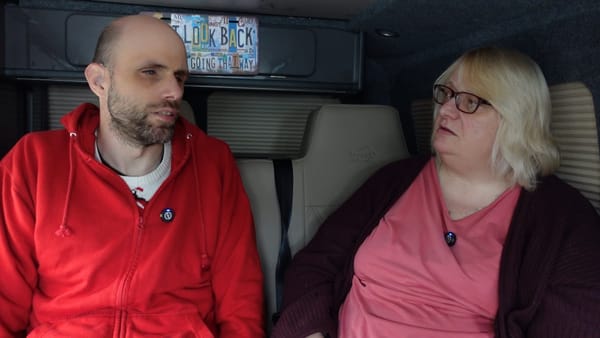
In our first video, John explains his mobility difficulties in his own words, talks about trying Glide and discusses what he needs to do to prepare.
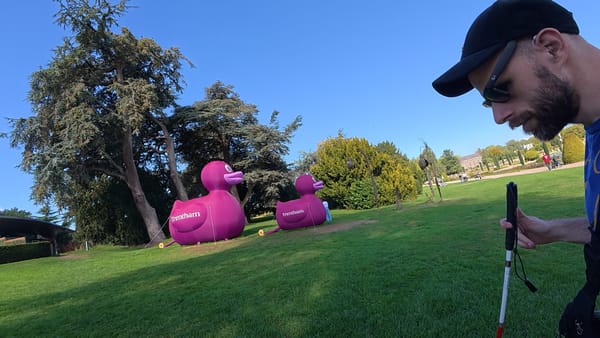
You'll also see footage of John using his white cane to shoreline, along with a short clip of him trying Glide at Northwest Guide Dogs.
Watch our YouTube video: Could a Robotic Guide Dog Change John's Life? | Glide Part 1
We'll be sharing further updates as John's preparations continue.
Special Needs Adventure Family – sharing disabled family days out, accessibility and everyday life with disabilities.